Showing posts with label textbook notes. Show all posts

Friday, November 5, 2010

Basic Speech Structure

I.                   Introduction

A.                 Attention getter
B.                 Psychological Orientation (Why should you listen to me?)
C.                  Logical Orientation (Why should you care about my topic?)
D.                 Thesis Statement & Preview of Main Points

[   Transition to first point  ]


II.                First Main Point

A.                 Subpoint
     1.                 Supporting Materials
B.                 Subpoint  
     1.                 Supporting Materials

[   Transition to second point  ]


III.             Second Main Point

A.                 Subpoint
     1.                 Supporting Materials
B.                 Subpoint  
     1.                 Supporting Materials

[   Transition to third point  ]

IV.              Third Main Point

A.                 Subpoint
     1.                 Supporting Materials
B.                 Subpoint  
     1.                 Supporting Materials

[   Transition to conclusion ]

V.                 Conclusion

A.                 Review of Main points
B.                 Psychological Closure
C.                  Clincher

Chapter 10: Arranging Points

¢  Arranging Points
  Arrange your main points in a pattern that makes sense for the topic and the thesis statement
¢  Chronological
¢  Ideas are based in a time sequence
¢  Ex. European Music: Baroque Period, Classical Period, Romantic Period
¢  Spatial Pattern
¢  Based on geography
¢  Ex. Crime: Eastern Seaboard, Midwest, Pacific Coast
¢  Cause-Effect
¢  Problem-Solution


Chapter 8: Research

¢  How to Start Researching:
  Sources of Information:
¢  Internet (Lexis-Nexis, academic journals)
¢  Library (books, encyclopedias, DVDs, etc.)
¢  Experts (your dad)
  Formulate questions:
¢  What do you want to find out about your speech topic? Write a list of questions that you can answer throughout your research.
¢  This will help structure your research and be a way to know when you have “finished.”
¢  Learn the Lexicon
  As you research you will discover new terms that are specific to the field
¢  Write down terms that are used frequently
¢  Make a list of definitions
¢  Learn to “talk the talk”
  This will help you understand your research and add to your credibility
¢  Interviewing
  Types of experts
¢  Educators
¢  Public Officials
¢  Agencies or Non-Profit Organizations
¢  Athletes
¢  Doctors
¢  Accountants
¢  Any professional
  Make a list of questions
¢  Avoid vague questions
¢  Don’t disagree, argue, or interrupt
¢  Send a thank you note
¢  Record Your Sources
  Use MLA or APA as your format for recording your sources
  Find an organizational system that works for you
¢  Note cards
¢  Notebook
¢  Word Document
  Record quotes and data in a way that you can easily find it later

Friday, October 22, 2010

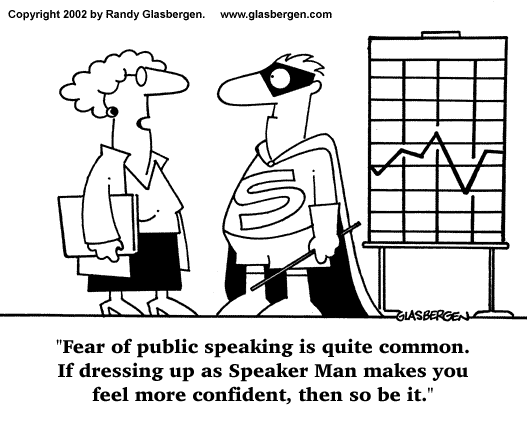
Chapter 4: Overcoming Fear of Speaking


Chapter 4: Overcoming Fear of Speaking

  • Specify your fear
    • A specific fear is easier to fix than a vague one. 
    • "I'm totally freaking out!"  versus "I'm worried about blanking out!
  • Good preparation will help you feel confident
    • D&C 38:30 "...but if ye are prepared ye shall not fear."
    • Develop a good outline and practice, practice, practice.
    • Pray for help to remember what you studied and prepared.
  • Visualize success
    • When you are experiencing fear and anxiety try imaging yourself confidently delivering the speech
  • Replace negative thoughts with positive ones
      • Replace Negative: "I'm going to say "um" to much." with Positive: "No one will notice if I say "um" a few times. They will notice my great content and know how hard I worked."
  • Try Relaxation Techniques
    • Fight or Flight: Your body reacts to fearful situations by preparing it for "fight" or "flight." Public speaking isn't as intense as fighting a tiger or running from one. So... what do we do with the increased heart rate, rush of adrenaline, and tense muscles?
    • Breathe! Force some oxygen to your brain. It will help you relax and focus.
      • Inhale through the nose and exhale through your mouth. It's the best way to slow down your breathing.
    • Go for a brisk walk
    • Do some neck rolls, knee bends, or arm swings.